


Quick answer
Choosing between waterless vs ultrasonic diffusers for wholesale in 2026 comes down to one question: which channel do you sell into? Because the split is fairly clean — waterless (nebulizing/UHF) diffusers are the commercial and premium private-label play, ultrasonic diffusers are the volume and entry-price play. A waterless unit atomizes undiluted oil, so it throws a stronger dry scent, needs no water, carries no standing-water mold risk, and scales from a 100 m³ / 3,531 ft³ portable up to a 2,000 m³ / 70,629 ft³ HVAC-ready machine. An ultrasonic unit vibrates a water-and-oil mix through a ceramic disc, so the mist also carries a little moisture around the unit, runs at a lower unit cost, and covers smaller rooms — but it needs refilling and cleaning far more often.
So the decision is not which technology is objectively better — it is which one your buyer will actually pay for. Hotels, spas, retail chains and offices buy waterless. Entry-price home, gifting, supermarket and dry-climate comfort markets buy ultrasonic. On margin, the rule we give every buyer still holds: a branded line needs retail pricing at 5× your EXW cost to leave roughly 30% net margin, while an undifferentiated standard model on a marketplace is usually capped near 3×. Waterless machines with a genuine unique selling point — a patented design, CNC alloy body, or HVAC integration — are the safer route to the first; ultrasonic usually lives in the second — unless you attach it to recurring oil sales.

Who this comparison is for
This is a sourcing comparison, not a bedroom review. Three readers get value here:
- Importers and wholesalers choosing which of the two lines to put cash into for the 2026 season.
- Private-label and OEM brand builders deciding which mechanism supports a price point worth defending.
- Retail and hospitality buyers who need to justify one technology over the other to a purchasing manager.
Everything below — oil consumption, warranty questions, MOQ entry points — is written for someone ordering by the carton, not by the unit. If you only want one machine for one room, the three-decision selection guide is the faster read.
The two mechanisms, in two sentences each
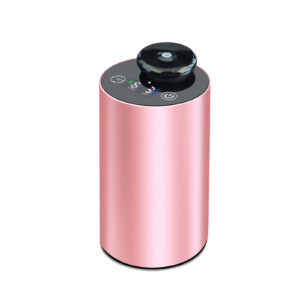
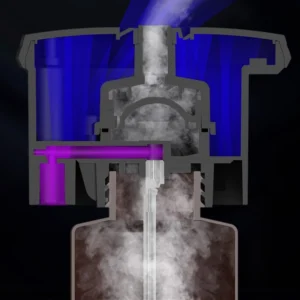
Waterless (cold-air nebulizing / UHF). A pump or a >3 MHz drive breaks undiluted essential or fragrance oil into a dry mist, with no water and no heat. Because nothing is diluted, the scent is stronger per millilitre, and the dry particles stay suspended 3–5× longer than a standard water mist — which is why one unit can hold a lobby rather than a corner. Our UHF range runs above 3 MHz at roughly 647 nm particle size, and our commercial nebulizers measure 36–38 dB.
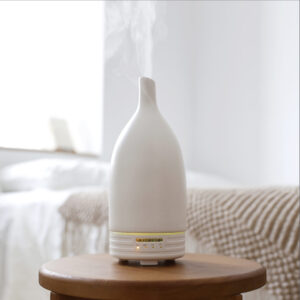
Ultrasonic (piezoelectric). A ceramic disc vibrating at 1.7–2.4 MHz turns a water-and-oil mixture into a cold mist. No heat means the oil is not thermally degraded, and the mist softens the air around the unit — worth a line in your copy for dry climates, but it is not a humidifier, and we will come back to that. Our units are built around 2.4 MHz ceramic atomizers and food-grade PP tanks, producing 30–45 ml/h of mist at under 35 dB, with automatic dry-run shut-off.
Note what that 30–45 ml/h figure actually measures: water mist, not fragrance. It is the single most common specification mistake in this category, and we come back to it below.
Waterless vs ultrasonic: the 15-point wholesale comparison
All figures are manufacturer-stated values from our live product pages. Where a value is not published, we write a pedido rather than estimate it.
| # | Dimension | Waterless (nebulizing / UHF) | Ultrasonic (piezoelectric) |
|---|---|---|---|
| 1 | Agua necesaria | No — oil only | Yes — water + oil |
| 2 | Scent strength | Stronger, undiluted; dry mist stays suspended 3–5× longer | Weaker, diluted by water |
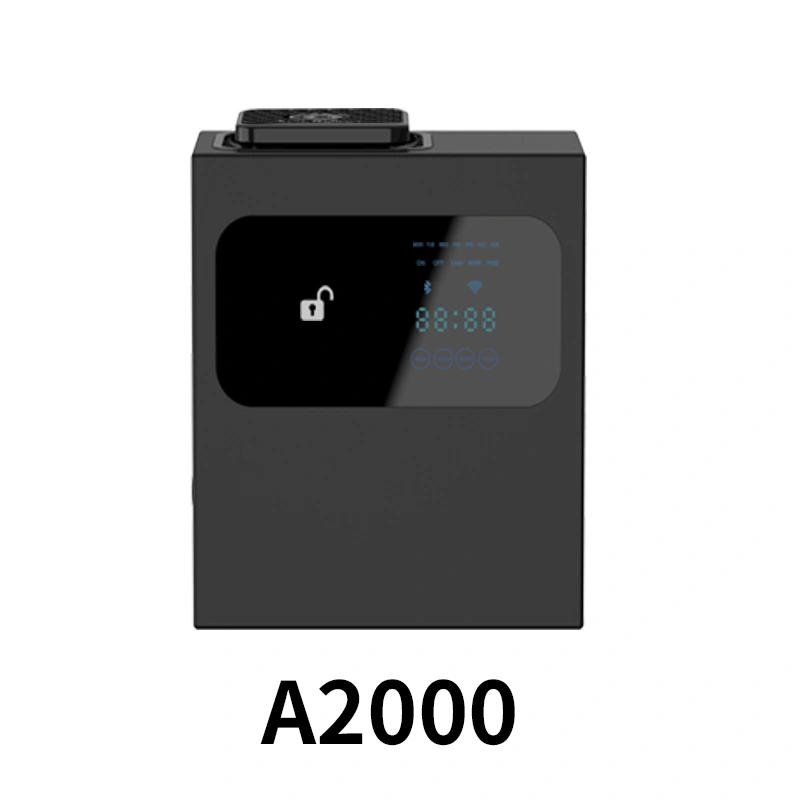
| 3 | Coverage as stated | By volume: m³. UD11 100 m³ / 3,531 ft³ → A2000 2,000 m³ / 70,629 ft³ | By area: m². 10–50 m² across 100 / 200 / 300 / 500 ml SKUs |
| 4 | Adds humidity | No (dry mist) | Local comfort only — softens the air around the unit, does not change room humidity |
| 5 | Oil use per hour | UD11: 0.1–0.2 ml/h. A2000: ≥2.08 ml/h / 0.07 fl oz/h | Dosed per fill, not per hour — at 4 drops/day, 1 ml / 0.03 fl oz lasts 5 days and 20 ml / 0.68 fl oz lasts 100 days at one use per day; mist output is 30–45 ml/h of water-oil |
| 6 | Refill interval | UD11 5 ml / 0.17 fl oz cartridge; A2000 1,000 ml / 33.81 fl oz tank ≈ 60 days at 8 h/day | 100–500 ml tank, 8–20 h runtime — refill daily in practice |
| 7 | Noise level | 36–38 dB on our commercial nebulizers; under 15 dB on UHF models such as the UD11 | Under 35 dB |
| 8 | Mantenimiento | Clean every 3–4 weeks — less often, but the oil path needs flushing when you change scents; no standing water, so no mold risk | Daily to weekly cleaning; scale builds on the ceramic disc; mold risk if neglected |
| 9 | Control & intervals | Buttons, Bluetooth 5.0, Wi-Fi (model-dependent); HVAC-ready on A2000; ≤12 W | Adjustable mist and timer, LED mood light, auto dry-run shut-off |
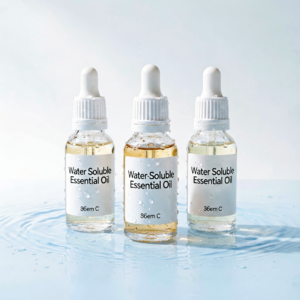
| 10 | Oil type required | Undiluted pure oil; UHF also accepts water-based oil | Water-oil mix; micro-mesh ultrasonic types require water-soluble oil |
| 11 | Best channel | Hotels, spas, retail chains, offices, HVAC zones, premium private label | Entry-price home and office, gifting, supermarkets, dry-climate markets |
| 12 | Price band | $7–$80 per unit, standard models, no minimum quantity | $2-$20 — factory-direct FOB, quoted per configuration |
| 13 | Customisation entry | Standard models carry no minimum; custom labelling and laser printing from 1 unit | Laser-engraved logo from 1 unit; full OEM (colour, material, packaging, manual) from 100 unidades |
| 14 | Warranty stated | 1-year full warranty, free replacement for manufacturing defects | 12-month warranty, free replacement parts for bulk buyers |
| 15 | Commercial use | Primary — this is what the category was built for | Viable in small commercial rooms and guest areas |
Why rows 3, 5 and 7 trip buyers up
Row 3 — coverage units. Waterless coverage on our pages is stated in cubic metres, because scent dosing tracks room volume. Ultrasonic coverage is stated in square metres, because the mist output is sized against a floor area. A “2,000 m³” waterless machine is not 2,000 “square metres”, and neither number can be lined up against the other without converting. If you need a floor figure from a volume rating, divide by your ceiling height: 100 m³ ÷ 2.7 m ≈ 37 m². Send us the dimensions and ceiling height and we will size it for you rather than let a spec-sheet comparison mislead you.
Row 5 — oil use vs mist output. Waterless oil consumption is quoted in ml of oil per hour; ultrasonic output is quoted in ml of mist per hour, and most of that is water. Comparing 2.08 ml/h against 45 ml/h compares oil to water. On the ultrasonic side, oil is dosed per fill: at 4 drops per day, 1 ml / 0.03 fl oz lasts 5 days and a 20 ml / 0.68 fl oz bottle lasts 100 days at one use per day. The honest cross-technology comparison is cost per covered volume per month, which depends on your oil price and duty cycle — we will run it for your case a pedido.
Row 7 — noise is a model figure, not a category one. We will not pretend waterless always wins here. Our commercial nebulizers measure 36–38 dB and our ultrasonic units sit under 35 dB, so on paper the ultrasonic is a couple of decibels quieter — a gap most people will not notice in a working space, but it is there. Where waterless clearly pulls ahead is the UHF range at under 15 dB. So choose on the model, not the category: for a guest room, a treatment room or anywhere silence is part of the product, ask for that model’s figure and what conditions it was measured under.
The commercial three: cost, margin and after-sales
Technology decides what a machine can do. These three decide whether the line makes money.
1. Running cost and margin structure
Waterless: high ticket, high margin, lower volume. The unit carries a higher price and, because it burns undiluted oil, a higher consumable cost per hour. You sell fewer units at a better multiple. The consumable is not a downside if you own it — this is the model behind wholesale oil programs, where hardware opens the account and refills carry the steadier margin.
Ultrasonic: low ticket, volume, and oil attachment. Water does most of the work, so the consumable cost per session is lower and the entry price is lower. Margin per unit is thinner, so the profit comes from turnover and from binding oil or accessory sales to the device.
The multiple you need. A branded line should be priced at at least 5× the EXW price you pay, because duties, advertising, channel fees and after-sales have to leave around 30% net. On marketplaces and in supermarkets, an undifferentiated model is typically capped near 3×. In price-sensitive markets the same standard unit can still reach 5× because local retail levels differ. A waterless machine with a genuine unique selling point — a patented design, CNC alloy body, or HVAC integration — is the safer route to the 5× end; a standard waterless model with no differentiation can end up capped near 3× like any other. Ultrasonic usually needs either volume or an oil subscription attached to clear the same bar.
First-batch caveat. On any custom project, the first trial batch is a validation step, not the profit step — development and tooling sit on it. Margin arrives on the first large reorder.
2. What 2026 demand actually looks like
We are not going to quote you one global number, because nobody in this category can. Published estimates for 2026 differ by more than an order of magnitude depending on scope — devices only, devices plus consumables, or the whole commercial fragrance market. Anyone who hands you a single confident figure has picked a scope and not told you which.
What the sources do agree on is the shape of the market, and that is what actually matters for a buying decision:
- Ultrasonic still leads on units. Independent estimates put ultrasonic somewhere between 55% and 69% of unit share, with nebulizing around 10–22%. Waterless is not displacing ultrasonic on volume, and it is not about to.
- Waterless leads on value and on growth. In France, for instance, ultrasonic is projected at 4–6% annual growth against 8–10% for nebulizing. Our own 2026 market analysis puts waterless nebulizing at 8.9% against an 8.6% category average — the same direction, from a different source.
- Commercial scenting is where waterless concentrates. Cold-air nebulization accounts for roughly three-quarters of the HVAC scent diffuser segment, with hospitality as its largest end user at around 37.5%. The hotel fragrance market on its own is estimated near $800 million in 2026.
That third point is the one to act on. Waterless growth is not coming from people replacing a bedroom diffuser — it is coming from hotels, retail chains and offices buying scent as a managed service. For our full internal figures, see the 2026 market analysis, and read them as compiled internal estimates: use them for direction, and verify against your own source before quoting them in an investor deck.
3. After-sales: what fails, and what to ask
The two technologies fail differently, and the failure mode is what generates your returns rate.
- Sin agua: the wearing parts are the atomizing pump or nozzle. They are mechanical, so they wear with hours run, not with water quality.
- Ultrasónico: the wearing part is the ceramic disc, and its enemy is scale from the water you put in it. Hard-water regions shorten disc life; neglected tanks grow mold. Our ceramic-bodied units are stated at a 3–5 year service life with a one-year warranty against manufacturing defects.
Where waterless costs you more. Being straight about this now saves a returns conversation later:
- Oil. It runs undiluted oil, so the consumable cost per hour is genuinely higher. That is not a defect — it is the reason the oil side of this business exists.
- Duty cycle. The scent is strong enough that most commercial installs run on intervals rather than continuously. Check that the model you buy actually has interval or scheduling control; the A2000 does.
- Viscosity. Thick or resinous oils are harder on the oil path than light citrus or floral oils, and they are the usual cause of a blocked nozzle. Match oil viscosity to the mechanism using the Guía de compatibilidad de aceites esenciales.
- Glass. Where a design uses a glass reservoir or column, pack for it. Glass is the one part that does not survive a drop, and it is worth asking whether spares ship separately from the main order.
Replacement cycles. Industry reports put household diffuser replacement at roughly 2–4 years, driven mostly by wear on ultrasonic transducers and pump mechanisms, and commercial hardware at about 4–6 years. Plan your reorder calendar around that, not around the warranty period.
Five warranty questions to ask any supplier before you sign — not just us:
- What is the warranty period, and does it cover the wearing part or only manufacturing defects?
- How long are spare parts guaranteed available after the model is discontinued?
- Are spare parts shipped with the main order, or only after a claim is filed?
- What is the actual repair or replacement turnaround, in days?
- Who answers a technical question, and in what response window and language?
Our published position: 1-year full warranty on waterless, free replacement for manufacturing defects; 12-month warranty on ultrasonic with free replacement parts for bulk buyers, plus a dedicated bilingual account manager. The full terms are on our after-sales service page. Certification documents — CE, FCC, RoHS as standard, with REACH, UL, PSE and country-specific reports available — are listed on our página de certificaciones.


Routing: pick by the channel you sell into
| Your channel | Recommended technology | Where to look |
|---|---|---|
| Hotel, spa, retail chain, office floor | Sin agua — coverage, no water, central scheduling | Gama sin agua · Para montaje en pared · HVAC |
| Whole floor or ducted building | Waterless HVAC — see A2000, 2,000 m³, HVAC-ready | A2000 |
| Premium private label, low MOQ | Waterless, CNC aluminium — tooling is cheap to open, finish supports a 5× multiple | A6000 · M202B · OEM/ODM |
| Entry-price home, office, supermarket | Ultrasónico — lowest ticket, plus the comfort of a little moisture in the mist | Rango ultrasónico |
| Gift sets, subscription boxes, hotel guest rooms | Either — small waterless portable or ceramic ultrasonic, depending on price point | UD11 portable waterless · Cerámica |
| Dry-climate market | Ultrasónico — the mist softens the air around the unit; sell it as comfort, not as a humidifier | Rango ultrasónico |
| You already have a signature pure oil | Sin agua — undiluted oil is the whole point | Oil compatibility guide |
Five sourcing mistakes we see repeatedly
Most waterless vs ultrasonic comparisons stop at the spec sheet. These five errors are the ones that actually cost importers money:
- Assuming waterless saves oil. It does not — it burns más pure oil per hour. What it saves is water handling, cleaning labour and complaint volume. The efficiency gain is scent delivered per millilitre, because dry mist stays suspended 3–5× longer.
- Reading ultrasonic ml/h as fragrance output. 30–45 ml/h is mostly water. Judge scent, not mist volume.
- Assuming the cheaper unit carries the better margin. A low-ticket ultrasonic that only supports a 3× multiple becomes the most expensive SKU in a brand line once ad spend and returns are counted.
- Assuming commercial means waterless only. A small treatment room, guest room or boutique is legitimately served by a ceramic ultrasonic. Buy to the space, not the category label.
- Comparing m³ with m². Covered above, and it is worth repeating: convert first, or send us the room.
Preguntas frecuentes
How waterless vs ultrasonic technologies differ
Do waterless diffusers need water?
No. A waterless (nebulizing or UHF) diffuser atomizes undiluted essential or fragrance oil directly, with no water and no heat. That is the source of most of its commercial advantages: stronger scent, no standing water, no mold risk, and cleaning every 3–4 weeks instead of daily. Ultrasonic diffusers do require water, because the ceramic disc atomizes a water-and-oil mixture.
Which type uses more oil?
Per hour, waterless — it runs on pure, undiluted oil, where ultrasonic dilutes a few drops into a tank of water. Our stated figures: UD11 portable uses 0.1–0.2 ml/h, the A2000 commercial unit ≥2.08 ml/h. Ultrasonic output is quoted as 30–45 ml/h of mist, most of which is water; on oil, ultrasonic doses per fill — at 4 drops/day, 1 ml / 0.03 fl oz lasts 5 days and 20 ml / 0.68 fl oz lasts 100 days. Per unit of scent actually delivered, waterless is more efficient, because dry mist stays suspended 3–5× longer than standard mist.
Which is quieter?
It is close, and it comes down to the model. Our commercial nebulizers measure 36–38 dB and our ultrasonic units sit under 35 dB, so the ultrasonic is a couple of decibels quieter — a difference most people will not notice in a working space, but we would rather say so than pretend otherwise. If silence is a real requirement, look at the UHF waterless range instead, rated under 15 dB. Check the model page, not the category.
Can both types run fragrance oils?
Broadly yes, but the rules differ by mechanism, and this is where buyers get burned. Waterless nebulizing runs undiluted oil; UHF also accepts water-based oil. Ceramic-piezo ultrasonic atomizes oil and water together and does not clog from a normal oil film, but micro-mesh ultrasonic types need water-soluble oil, because their apertures block. The full mechanism-by-mechanism rules are in our Guía de compatibilidad de aceites esenciales.
Can I compare the coverage figures directly?
Not without converting. Waterless coverage is stated in cubic metres because scent dosing tracks volume; ultrasonic coverage is stated in square metres because mist output is sized against floor area. To get a floor figure from a volume rating, divide by ceiling height — 100 m³ ÷ 2.7 m ≈ 37 m². Send us the room dimensions and ceiling height and we will size it properly.
Margin, warranty and ordering
Which gives retailers better margins?
Waterless, as a rule — but only when the machine has a unique selling point worth defending. A differentiated waterless unit (patented design, CNC alloy, HVAC-ready) supports the multiple a brand needs: retail at least 5× your EXW cost so duties, advertising, channel fees and after-sales leave roughly 30% net. A standard undifferentiated waterless model can end up capped near 3×, just like an ultrasonic on a marketplace. Ultrasonic still works — but it works on volume, or with recurring oil sales attached to the device.
What warranty should I expect from a diffuser supplier?
Ask five things, in writing: the warranty period and whether it covers the wearing part or only manufacturing defects; how long spares stay available after a model is discontinued; whether spares ship with the main order or only after a claim; the real repair turnaround in days; and who answers technical questions, in what window and language. For reference, we publish a 1-year full warranty on waterless models with free replacement for manufacturing defects, and a 12-month warranty on ultrasonic units with free replacement parts for bulk buyers.
Which is better for hotels?
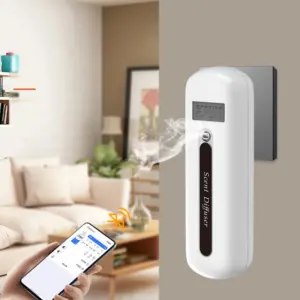
Waterless, for three practical reasons: coverage is specified by room volume and scales to lobbies and ducted zones, there is no water to refill or to grow mold in a room that sits empty, and cleaning lands on a 3–4 week cycle rather than a daily one. Wall-mounted and HVAC-connected waterless units also let you run a scent programme centrally. Ceramic ultrasonic units remain a sensible fit for individual guest rooms.
What is the MOQ if I want to test before committing?
Standard waterless models carry no minimum quantity, and custom labelling and laser printing are available from 1 unit. On ultrasonic, laser-engraved logos also start at 1 unit, while full OEM work — colour, material, packaging and manuals — starts at 100 units. Sample lead times are 1–2 days on waterless and 24–72 hours on ultrasonic, with production at 5–7 days for stock and 15–25 days for full custom. Start with a solicitud de muestra.
Hable con nosotros
So, waterless vs ultrasonic — which should you wholesale in 2026? Waterless if you sell into hotels, spas, retail chains, offices or premium private label and need the 5× multiple. Ultrasonic if you compete on entry price, volume or the comfort-in-dry-air angle, and can bind oil refills to the device. Most distributors end up carrying both, split by channel rather than by preference.
Send us your channel, your target retail price, and the room dimensions you need to cover. We will come back with the closest in-stock models, their stated coverage, and — for a brand — the custom path that supports your margin. Browse the full machine catalog, leer Cómo elegir un difusor for the wider framework, or check Cómo funcionan los pedidos al por mayor if this is your first China order.


 English
 Spanish